

AI LED original core patents · 12 patents · 3 countries
AI LEDthe original pioneer
Original core technology, proven by patents — Zerabio got there first.
A UV-C LED with enough output to replace mercury lamps. A metal substrate instead of sapphire, a 2D p-electrode instead of a point contact — the two structural causes of high-power failure are gone.
Power conversion efficiency
Industry avg. 3–7 %
Operating lifetime
Industry avg. 8,000 h
Peak wavelength
Germicidal optimum
Manufacturing cost
vs. competitors
01 — Performance
Single-chip output, measured
For UV-C LEDs, single-chip output is the one figure that decides whether a lamp can be replaced. Read it apart from multi-chip totals.
02 — Structure
What is different
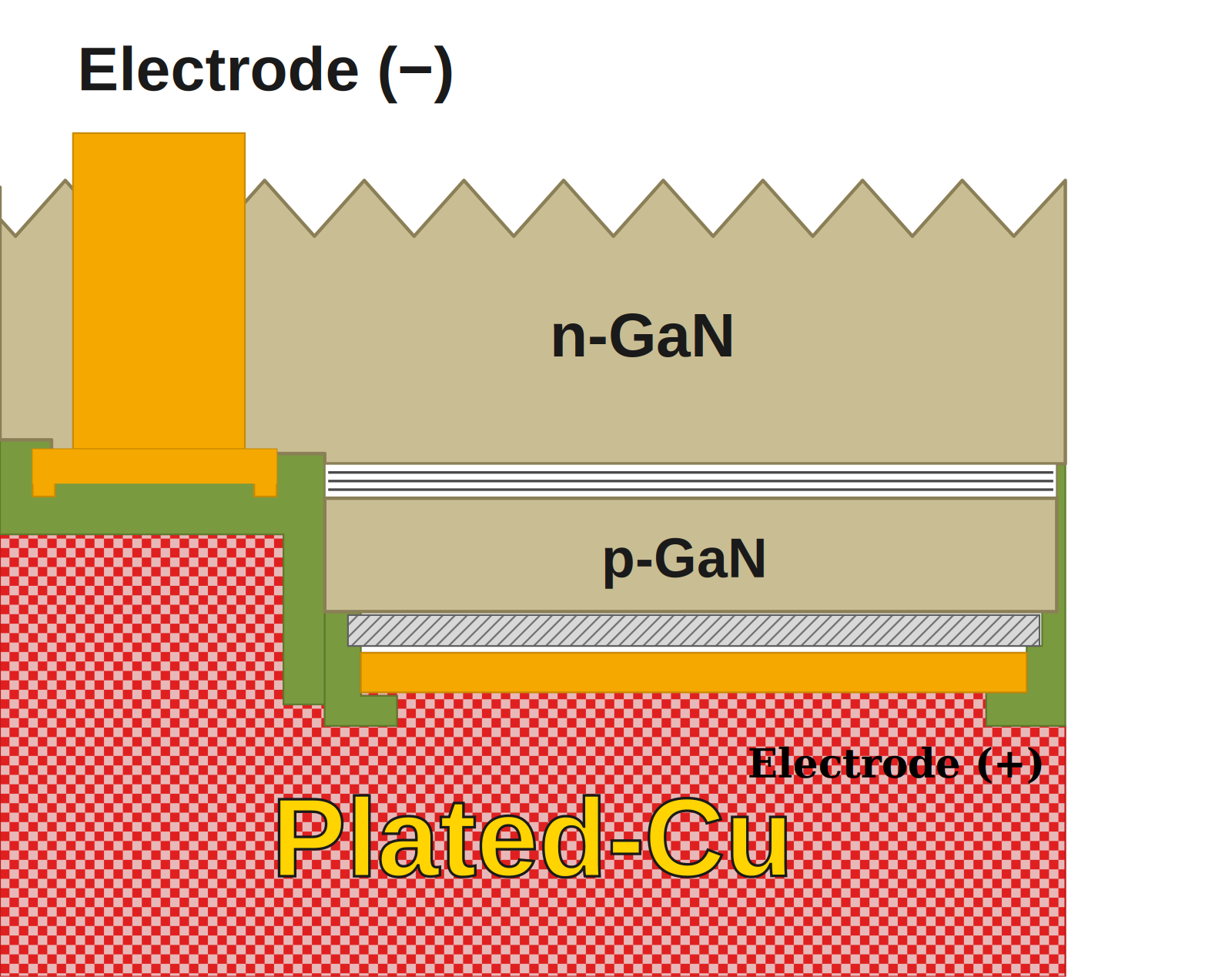
HHP keeps the vertical structure's strengths — full emitting area and a metal substrate — and removes its one remaining weakness: the point-contact electrode. Three structural choices, one chip.
Textured n-GaN surface
The entire top surface emits. Micro-texturing scatters light out of the crystal instead of trapping it, so extraction efficiency rises without any added optics.
2D p-electrode
The electrode is formed as a plane on a highly doped layer, not a point. Current spreads evenly, crowding disappears, and forward voltage stays low — efficiency in lm/W holds at high drive current.
Plated-Cu substrate
Copper replaces sapphire under the junction. Thermal conductivity rises threefold, heat does not accumulate, and lifetime extends to 15,000 h.
| Lateral | Vertical | HHP | |
|---|---|---|---|
| Emitting area | ~80% | >90% | >90% |
| Heat dissipation | 1× | >3× | >3× |
| Current spreading | ★☆☆ | ★★☆ | ★★★ |
| High-current efficiency | Droops | Declines | Maintained |
AI LED — the hardware core
Single chip. 150–300 mW.
AI LED systems need a precise, stable source that control algorithms can trust. ZeraBio's HHP UV-C LED delivers 150–300 mW from one chip — no multi-chip variance, no averaging. One source, one control loop, full dose accountability.
Precision at the source
Single-chip output eliminates multi-die averaging. AI dose controllers see exactly what they command — 150 mW in, 150 mW out.
Real-time dose control
Output modulates to match flow rate, contamination level, or exposure window. AI systems gain a direct handle on UV-C dosage.
Original AI LED patents
12 patents covering the HHP chip architecture — the IP foundation that makes high-power AI LED viable at scale.
03 — Regulation and market
Under the Minamata Convention, mercury lamps are being phased out.
The only replacement source is the UV-C LED. One question remains — is there enough output to replace a lamp. ZeraBio is currently the sole commercial supplier above 150 mW on a single chip.
2025 market size
2030 projection
CAGR
Fig. 5 — Growth drivers: Minamata Convention · semiconductor scaling demand · source required
04 — Applications
Where it goes
05 — Intellectual property
12 patents · 3 countries
06 — Contact
We will send
the datasheets.
Tell us your application and the specifications you need, and we will send the matching datasheets.